The top profile of a wood fence is one of the first design features people notice. While the fence material, height, and construction determine its durability and privacy, the shape of the picket tops influences the fence's overall appearance and how well it complements your home.
Some homeowners prefer a clean, modern profile, while others want a more decorative look that enhances the property's appearance. Understanding the differences between common wood fence top styles can help you choose a design that matches your property, neighborhood, and personal preferences.
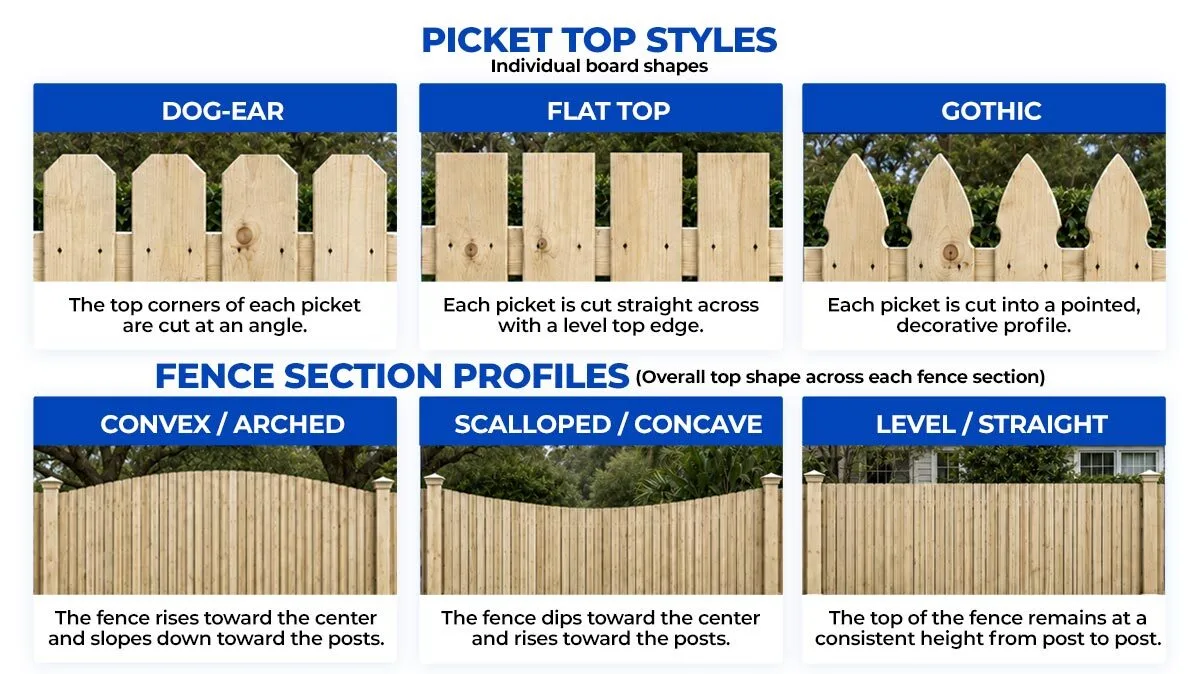
This guide explains six of the most common wood fence top styles used for residential fencing: dog-ear, flat-top, Gothic, convex, concave (scalloped), and straight (level).
For most residential wood fences, the top style affects appearance more than privacy or structural performance. However, it can influence how the fence is built, maintained, and repaired over time.
Different top profiles change the amount of exposed end grain, whether cap boards can be installed easily, and how simple it is to replace individual pickets if they become damaged. Decorative cuts such as Gothic, convex, and concave profiles may also require matching replacement pickets to maintain a consistent appearance.
Regardless of the top profile, wood naturally expands and contracts with seasonal moisture changes. It may also develop checks, surface cracks, cupping, or color changes as it ages. Proper installation, drainage, lumber quality, and routine maintenance generally have a greater impact on the fence's longevity than the picket shape itself.
The most common wood fence top styles include:
| Style | Appearance | Best For |
| Dog-Ear | Corners clipped at 45° | Traditional privacy fences |
| Flat Top | Straight horizontal top | Modern homes |
| Gothic | Pointed pickets | Decorative front yards |
| Convex | Upward arch across each section | Decorative privacy fences |
| Concave (Scalloped) | Downward curve across each section | Traditional decorative fencing |
| Straight (Level) | Uniform picket height | Contemporary privacy fences |
While the top style changes the fence's appearance, privacy depends primarily on the fence design, picket spacing, height, and overall layout rather than the shape of the picket tops. The top profile mainly influences the finished look of the fence.
A dog-ear fence is a common wood fence style used in many residential settings. Each picket has its upper corners cut at a 45-degree angle, creating the familiar "dog-ear" shape.
Besides providing a traditional appearance, the clipped corners remove the sharp square edges found on flat-top pickets, but they do not prevent wood from checking, splitting, cupping, or weathering over time. Like any wood fence, long-term performance depends more on lumber quality, installation methods, drainage, and maintenance than on the shape of the picket.
Dog-ear fences are commonly used for backyard privacy and blend well with many home styles.
Best for
Many homeowners use these terms interchangeably, but they describe different aspects of the fence.
A flat-top fence refers to the shape of each individual picket. Every board is cut square across the top, creating a clean, flat edge.
A straight or level fence describes the finished fence line after installation. The pickets are installed so the tops align evenly across each section, creating a consistent horizontal appearance.
In many residential privacy fences, a flat-top picket also creates a straight fence line, so the two terms often overlap.
Unlike privacy fences, Gothic fences use pointed pickets to create a decorative profile inspired by traditional architectural designs.
Because of their open design, Gothic fences are most commonly installed in front yards, gardens, and decorative property boundaries rather than as full privacy fences.
Some manufacturers also offer French Gothic pickets, which feature a rounded notch below the pointed tip for additional visual detail.
Best for
A convex fence gradually rises toward the center of each fence section, creating an upward arch.
The curved profile is created by varying the height of the individual pickets while maintaining consistent spacing. Convex tops add visual interest without significantly reducing privacy, making them popular for decorative backyard fencing.
Best for
A concave fence, often called a scalloped fence, curves downward toward the center of each fence section.
The soft curve adds architectural interest while maintaining nearly the same level of privacy as a straight-top fence. Although many people use the terms interchangeably, some manufacturers distinguish between a gentle concave curve and a more pronounced scalloped profile.
Best for
A straight or level fence keeps every picket at the same height, producing a clean, uninterrupted top line.
Unlike a flat-top fence, which often refers to the picket shape itself, a straight fence describes the overall level alignment of the fence across each section. This timeless design works well with many architectural styles and remains a common choice for residential privacy fencing.
Best for
Some wood fence top styles work better with cap-and-trim details than others.
Flat-top and straight privacy fences are commonly paired with cap boards because the level fence line provides continuous support for the cap. This creates a finished appearance while helping protect the exposed tops of the pickets.
Dog-ear, convex, concave, and Gothic styles are more often installed without cap boards so their decorative profiles remain visible. While custom trim can sometimes be incorporated into these styles, it typically requires additional fabrication and planning.
If you're considering cap and trim, discuss those options before installation so the fence layout, post spacing, and overall design can be planned accordingly. Gate design should also be considered because the gate top usually needs to match or complement the fence profile.
Choosing the right fence top style depends on more than looks. Consider how the fence complements your home's architecture, landscaping, neighborhood character, and any applicable HOA guidelines. Decorative profiles such as Gothic, convex, and concave add visual interest, while dog-ear and straight styles provide a more traditional look for privacy fencing.
If you're comparing styles, viewing completed fence installations or sample panels can make it easier to visualize how each profile will look on your property.
| Style | Typical Privacy | Decorative Detail | Common Use | Notes |
| Dog-Ear | High | Low | Backyard privacy | Traditional residential style |
| Flat Top | High | Low | Modern privacy fences | Often paired with cap and trim |
| Gothic | Low to Moderate | High | Front yards and decorative fencing | Open picket design |
| Convex | High | Moderate | Decorative privacy fences | Arched fence line |
| Concave (Scalloped) | High | Moderate | Decorative residential fencing | Curved fence profile |
| Straight (Level) | High | Low | Standard privacy fencing | Simple, clean appearance |
There isn't a single best wood fence top style for every property. The right choice depends on whether your priority is creating a traditional backyard privacy fence, adding decorative front-yard design, or matching your home's architectural style. Dog-ear and straight profiles remain among the most popular choices for residential privacy fencing, while Gothic, convex, and concave styles provide more decorative alternatives.
Before making a final decision, compare different top profiles in person, review any neighborhood or HOA requirements, and discuss your options with a professional fence contractor. Seeing full-size fence panels and understanding how each style fits your property can help you choose a design that fits the property and maintenance expectations before installation begins.
Choosing the right wood fence top style involves more than selecting the profile you like best. Fence height, wood species, picket thickness, gates, cap-and-trim options, site conditions, maintenance expectations, and neighborhood requirements can all influence the final design.
A wood fence estimate can help compare these options, so you understand the scope of the project before construction begins. Homeowners ready to review options can request a wood fence estimate.


