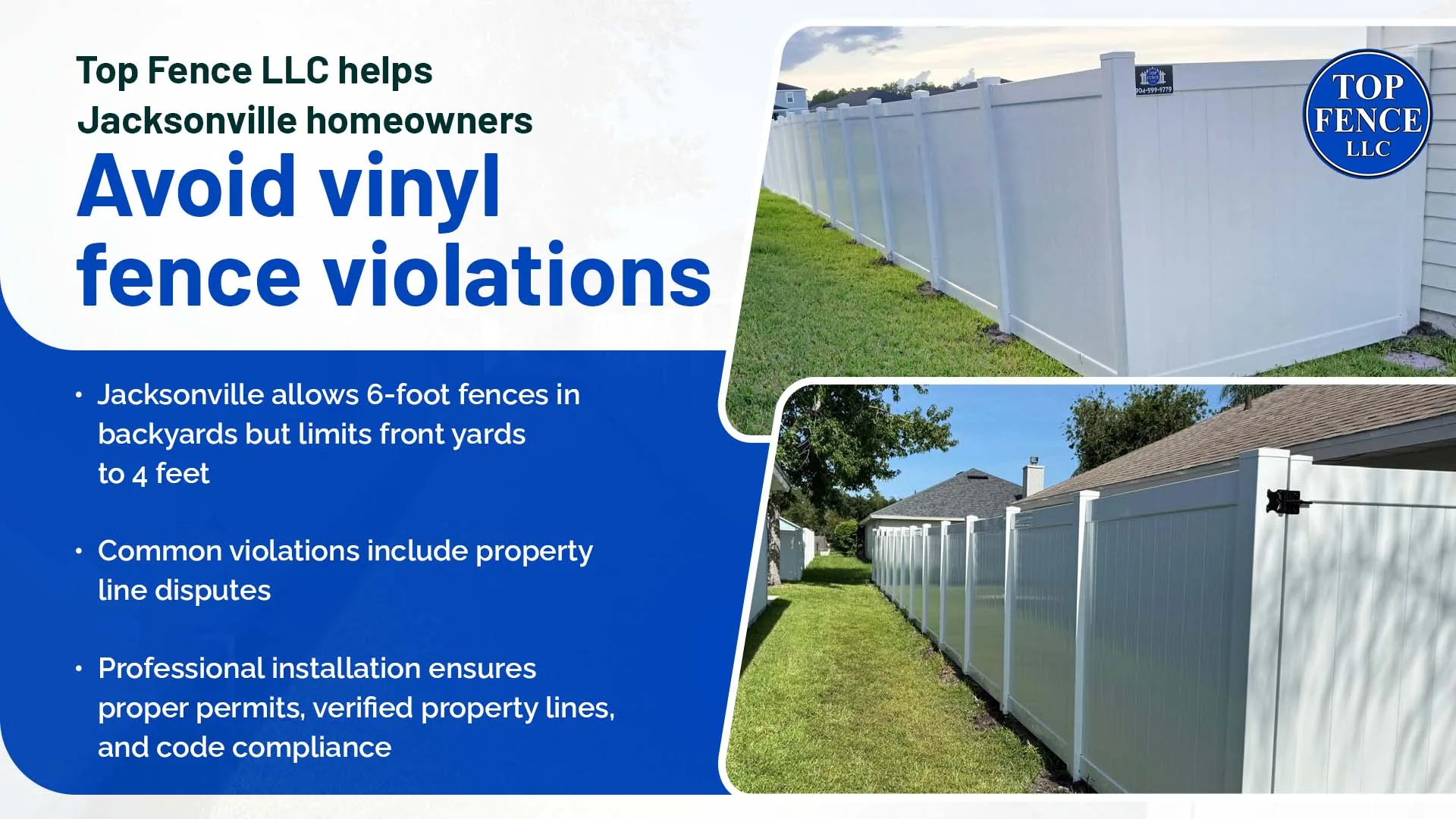
Most residential vinyl fences in Jacksonville can be 6 feet tall in backyards and 4 feet tall in front yards. St. Johns County follows similar limits but adds stricter corner lot rules. Both areas require permits for fences over 6 feet, and HOA restrictions may lower these maximums.
Understanding fence height regulations protects you from costly violations and removal orders. Jacksonville and St. Johns County enforce specific rules about how tall your vinyl fence can be, where you can place it, and what permits you need. These regulations exist to maintain neighborhood appearance, protect sight lines at intersections, and make sure property disputes stay minimal.
At Top Fence LLC, we know that getting your fence height wrong can lead to costly fines and forced removal. As a Jacksonville fence company familiar with local codes, we help homeowners avoid these issues. This guide explains vinyl fence height regulations in both Jacksonville and St. Johns County, so you know what applies before you build.
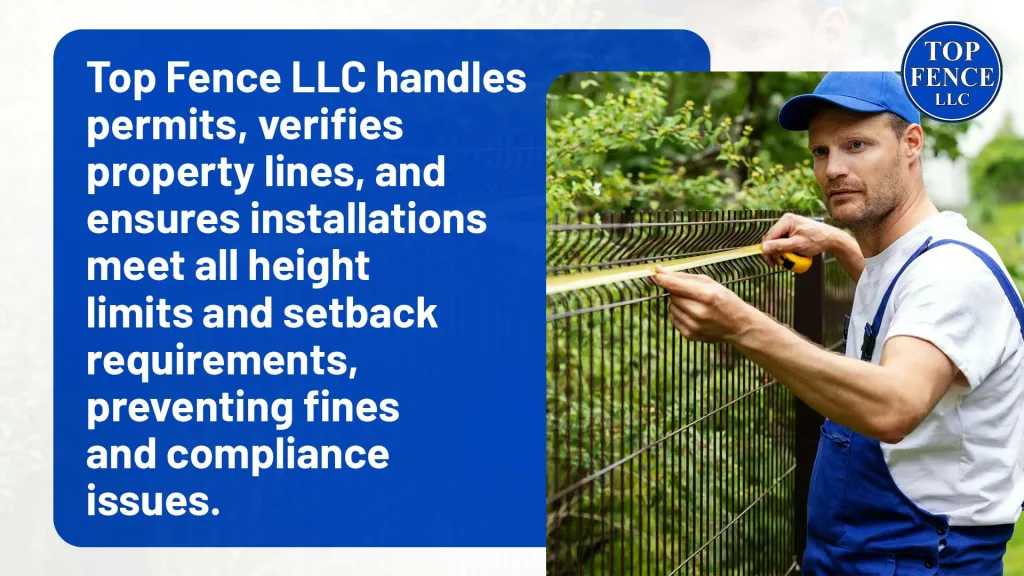
Front and back yard heights differ. Jacksonville and St. Johns County allow 6-foot fences in backyards but limit front yards to 4 feet. Know which areas of your property count as front yards.
Corner lots face stricter rules. Both street-facing sides count as front yards on corner properties. This doubles the area where 4-foot height limits apply.
HOAs can enforce stricter standards. Your homeowner association might require shorter fences or specific styles. Check HOA rules before planning installation.
Permits prevent costly violations. Both jurisdictions require permits for most residential fences. Unpermitted fences lead to fines and forced removal.
Professional installation helps maintain compliance. Licensed fence companies in Jacksonville handle permits, verify measurements, and install fences that meet all regulations.
Jacksonville allows 6-foot fences in rear and side yards. Front yard fences cannot exceed 4 feet in height. These measurements apply from ground level to the top of the fence, including any decorative elements or post caps.
Corner lots face additional restrictions. The front yard setback extends along both street-facing sides of your property. This means your 4-foot limit applies to a larger area than interior lots. Many homeowners don't realize their side yard counts as a front yard under Jacksonville code.
In Jacksonville, residential fences typically require permits when they exceed 6 feet in height or are located within designated flood zones. The permit process typically takes 2-3 business days for standard vinyl fence installations.
Swimming pool fences have separate requirements. Florida law mandates specific height and gap measurements for pool barriers, regardless of city rules. Your fence must be at least 4 feet tall with no gaps larger than 4 inches.
St. Johns County requires permits for most residential fences. You need approval before installing any fence over 6 feet tall. The county also requires permits for fences in easements, floodplains, or within setback areas.
The permit application requires a property survey showing fence placement. You'll submit a site plan marking your property lines, existing structures, and proposed fence location. St. Johns County reviews these plans to verify setback compliance and easement avoidance.
Processing times vary from 3 to 10 business days, depending on application complexity. Simple backyard fence permits are often approved within a week. Projects near easements or in special flood zones take longer.
St. Johns County Building Services charges permit fees based on project value. This fee covers plan review and one inspection after installation.
Fence companies in Jacksonville handle permit applications as part of their service. Working with a licensed fencing company in Jacksonville makes sure your paperwork meets county requirements and speeds up approval.
Setbacks determine where a fence can be placed in relation to property lines. In Jacksonville, fence placement is regulated by front yard restrictions rather than a fixed setback distance.
Fences located within the required front yard are generally limited to 4 feet in height, while taller fences must be placed outside the required front yard or receive zoning approval. Side and rear property lines typically allow fences at or near the boundary, depending on zoning and lot conditions.
In St. Johns County, front yard setback requirements vary by zoning and lot type, with corner lots often subject to larger front or street-side setbacks to maintain visibility at intersections. Interior lots generally follow similar front yard height limitations rather than a specific numeric fence setback.
Utility easements can further affect fence placement. Property deeds and surveys identify easement areas where utility providers retain access rights. Fences installed within these areas may need approval and are often required to remain removable.
Accurate setback planning depends on a current property survey. The front property line is not always where the lawn meets the street, as public rights-of-way frequently extend beyond the visible curb or sidewalk.
A residential fence company reviews surveys, confirms easements, and plans fence placement that aligns with local zoning rules before construction begins.
| Regulation Aspect | Jacksonville | St. Johns County |
| Backyard Maximum Height | Up to 6 feet in most residential zones | Up to 6 feet in most residential zones |
| Front Yard Maximum Height | Generally limited to 4 feet within the required front yard | Generally limited to 4 feet within the required front yard |
| Corner Lot Restrictions | Street-side yard height and placement limits apply; no fixed setback distance | Larger street-side setback or visibility restrictions often apply, depending on zoning |
| Permit Trigger | Permits commonly required for fences over 6 feet or in special areas | Permits commonly required for fences over 6 feet or in special areas |
| Side Yard Placement | Often allowed on or near the property line, subject to zoning | Often allowed on or near the property line, subject to zoning |
| Pool Fence Minimum Height | Minimum 4 feet, with safety gate requirements | Minimum 4 feet, with safety gate requirements |
| Typical Permit Cost | Varies by project and location | Varies by project and location |
| Processing Time | Often a few business days for standard residential fences | Typically, several business days, depending on review needs |
Homeowner associations can enforce stricter rules than city or county codes. Your HOA might limit fence height to 5 feet, even though Jacksonville allows 6 feet. HOA rules also commonly restrict fence styles, colors, and materials.
Check your HOA covenants before planning fence installation. Most associations require architectural review board approval. This process adds 2-6 weeks to your project timeline.
HOAs cannot make rules less restrictive than city codes. If Jacksonville limits front fences to 4 feet, your HOA can't approve a 5-foot front fence. City and county regulations always represent the maximum allowable standards.
Many neighborhoods in Nocatee, Ponte Vedra, and Fruit Cove have active HOAs with specific fence requirements. These communities often mandate vinyl fence colors that match home exteriors. Some restrict fence placement to backyards only.
Fence companies near you familiar with local HOAs streamline the approval process. Experienced contractors know which fence styles typically receive HOA approval in your neighborhood.
Code enforcement can require fence changes or removal when violations occur. Property owners are usually given time to correct the issue before fines begin, with penalties increasing if the violation remains unresolved.
St. Johns County follows similar enforcement procedures. Neighbors commonly report fence violations, especially when fences block views or exceed height limits noticeably. Code officers also spot violations during routine neighborhood inspections.
Violations discovered during home sales cause transaction delays. Title companies flag unpermitted or non-compliant fences during closing. You'll need to remove the fence, obtain retroactive permits, or reduce fence height to complete the sale.
Legal disputes with neighbors over fence violations get expensive quickly. Property line disagreements and height violations often lead to civil court cases costing thousands in legal fees.
Hiring fence companies in Jacksonville prevents these problems. Licensed contractors verify regulations, obtain permits, and install fences that meet all applicable codes.
Height measurements start at ground level on the higher side of sloped properties. If your yard slopes, the measurement uses the elevation where the fence sits tallest. This prevents people from exploiting grade changes to build taller fences.
Post caps, finials, and decorative elements count toward total height. A 6-foot fence with 4-inch post caps measures 6 feet 4 inches total. This exceeds the maximum in many situations.
Lattice toppers and decorative panels also count in height calculations. Some homeowners try adding these elements to effectively increase fence height. Code enforcement includes these additions in violation determinations.
Retaining walls with fences on top combine heights. A 2-foot retaining wall with a 6-foot fence creates an 8-foot barrier. This configuration requires special permits and engineering approval in both Jacksonville and St. Johns County.
Professional fence companies in Jacksonville measure height correctly during planning. They account for slopes, decorative elements, and combined structures to keep your installation compliant.
Corner lots have two front yards under most zoning codes. The 4-foot height limit applies to both street-facing sides. This significantly reduces privacy fencing options compared to interior lots.
Lots (properties with street frontage on opposite sides) face even stricter rules. Both front and rear property lines count as front yards. These properties often cannot install 6-foot privacy fences without special variances.
Sight-triangle rules restrict fence placement near intersections to maintain clear visibility for drivers and pedestrians. In Jacksonville, fences located within designated visibility areas at corners must remain low and unobstructive, regardless of whether they are in the front, side, or rear yard.
Some corner-lot owners may request zoning relief to allow taller fencing outside these visibility areas. Approval depends on site conditions and whether the proposed fence preserves traffic safety and neighborhood standards. The review process involves a formal application and public evaluation and may take several weeks or longer, depending on the request.
A fencing company in Jacksonville experienced with corner lots knows which fence designs work within regulations. They can suggest layout options that maximize privacy while maintaining code compliance.
Property line disputes are the most common cause of fence-related legal problems. A professional survey may cost more upfront, but it helps avoid property line disputes, compliance issues, and costly corrections later. Surveys clearly mark property boundaries and identify easements.
St. Johns County often requires surveys for fence permits. The county wants verification that your fence stays on your property and respects all setbacks. Jacksonville doesn't always require surveys, but strongly recommends them.
Older property surveys may not reflect current conditions. Property lines don't change, but physical markers like stakes and pins disappear over time. A new survey provides accurate fence placement.
Shared property line fences require neighbor agreement regardless of survey results. Even if your fence sits entirely on your property, placing it directly on the boundary line needs neighbor cooperation in most cases.
Fence companies near you can recommend surveyors familiar with your neighborhood. Some fencing companies coordinate survey scheduling as part of their installation service.
Replacing damaged fence sections must maintain original height compliance. You cannot use repairs as an opportunity to increase fence height beyond permitted levels. Repairing a non-compliant fence doesn't grandfather in the violation.
Vinyl fence repair in Jacksonville often involves matching existing fence styles. If your current fence violates height codes, repairs offer a chance to bring everything into compliance. Some homeowners lower entire fences during major repair projects to avoid future violations.
Storm damage creates special situations. Insurance companies may require code-compliant replacement even if your original fence exceeded height limits. Hurricane damage in Jacksonville and the surrounding areas has led to many fence replacements in recent years.
Maintenance and repairs don't typically require new permits. However, replacing more than 50% of a fence's length may trigger permit requirements. Jacksonville and St. Johns County consider extensive repairs as new installations.
Working with a residential fence company makes sure repairs maintain compliance. Professional installers verify current regulations before completing any repair work.
Understanding Jacksonville and St. Johns County fence regulations doesn't have to be complicated. Top Fence LLC handles every compliance detail from permit applications to final installation. Our team knows local codes, HOA requirements, and property line best practices.
We serve Jacksonville, St. Johns County, Jacksonville Beach, Nocatee, Fruit Cove, Palm Valley, St. Augustine, and Ponte Vedra with award-winning fence installation. Our satisfaction guarantee and military discount make quality fencing affordable.
Call (904) 999-9779 to schedule your free consultation. We'll review your property, explain applicable regulations, and design a vinyl fence that maximizes privacy while meeting all height requirements. Visit our website to learn more about our commitment to quality installations throughout Northeast Florida and nearby areas.


